



By Michael Kanellos, Head of Influencer Relations, Marvell and Vienna Alexander, Marketing Content Intern, Marvell
Is copper dead?
Not by a long shot. Copper technology, however, will undergo a dramatic transformation over the next several years. Here’s a guide.
1. Copper is the Goldilocks Metal
Copper has been a staple ingredient for interconnects since the days of Colossus and ENIAC. It is a superior conductor, costs far less than gold or silver and offers relatively low resistance. Copper also replaced aluminum for connecting transistors inside of chips in the late 90s because its 40% lower resistance improved performance by 15%1.
Copper is also simple, reliable and hearty. Interconnects are essentially wires. By contrast, optical interconnects require a host of components such as optical DSPs, transimpedance amplifiers and lasers.
“The first rule in optical technology is ‘Whatever you can do in copper, do in copper,’” says Dr. Loi Nguyen, EVP of optical technology at Marvell.
2. But It’s Still a Metal
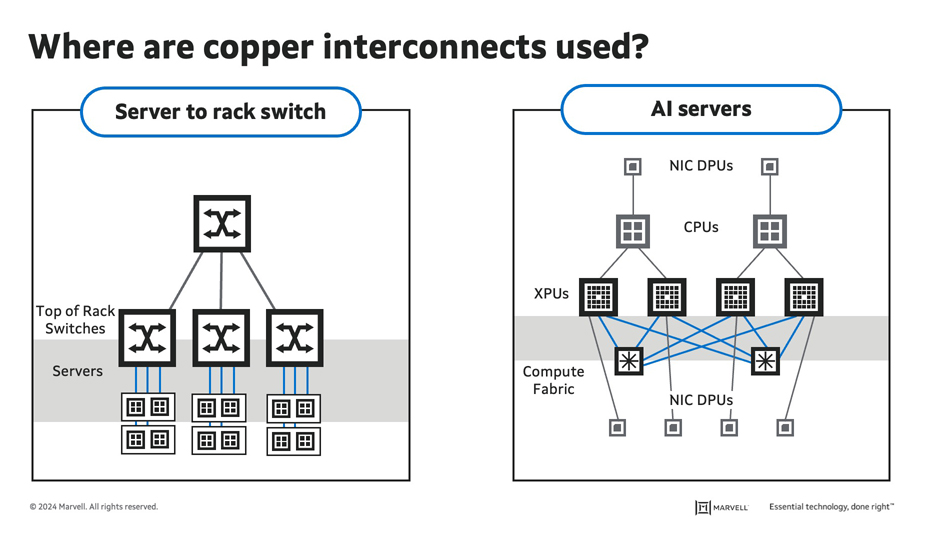
Nonetheless, electrical resistance exists. As bandwidth and network speeds increase, so do heat and power consumption. Additionally, increasing bandwidth reduces the reach, so doubling the data rate reduces distance by roughly 30–50% (see below).
As a result, optical technologies have replaced copper in interconnects five meters or longer in data centers and telecommunication networks.
Source: Marvell
Open Networking is not a new concept. SONiC (the Software for Open Networking) has been around for some time, and cloud-managed campus switches based on proprietary NOS (Network Operating System), are also not new. What’s truly novel is the comprehensive solution that finally brings open-source SONiC to the campus networks and adds to it a layer of cloud management and zero trust provisioning, all running on a cost-optimized hardware platform specifically tailored to campus networks: “Cloud Managed Enterprise” or CME.
In recent years, Open Networking offered the hyperscale operators the option to use open-source software on a variety of merchant silicon, providing freedom from the lockdown imposed by the big system vendors. The next challenge was to bring similar benefits to campus networks, particularly to what is now referred to as CME.
This blog will demonstrate how the Marvell ® Prestera® switches, equipped with a comprehensive Software Development Kit, along with the collaborative efforts of a vibrant industry community called OpenLAN Switching (OLS), have created this open cloud-managed solution for campus networks.
The power of a community
The first thing to recognize is that it took teamwork from multiple companies to create this open solution. Under the umbrella of the Telecom Infra Project (TIP), various companies gathered and created a working group called OpenLAN. Within OpenLAN, two sub working groups formed: OpenWi-Fi and OpenLAN Switching (OLS), which is the subgroup relevant to this discussion.
Numerous companies actively participated in the collaborative effort—Figure 1 mentions just some of them—organized according to their role in the solution.
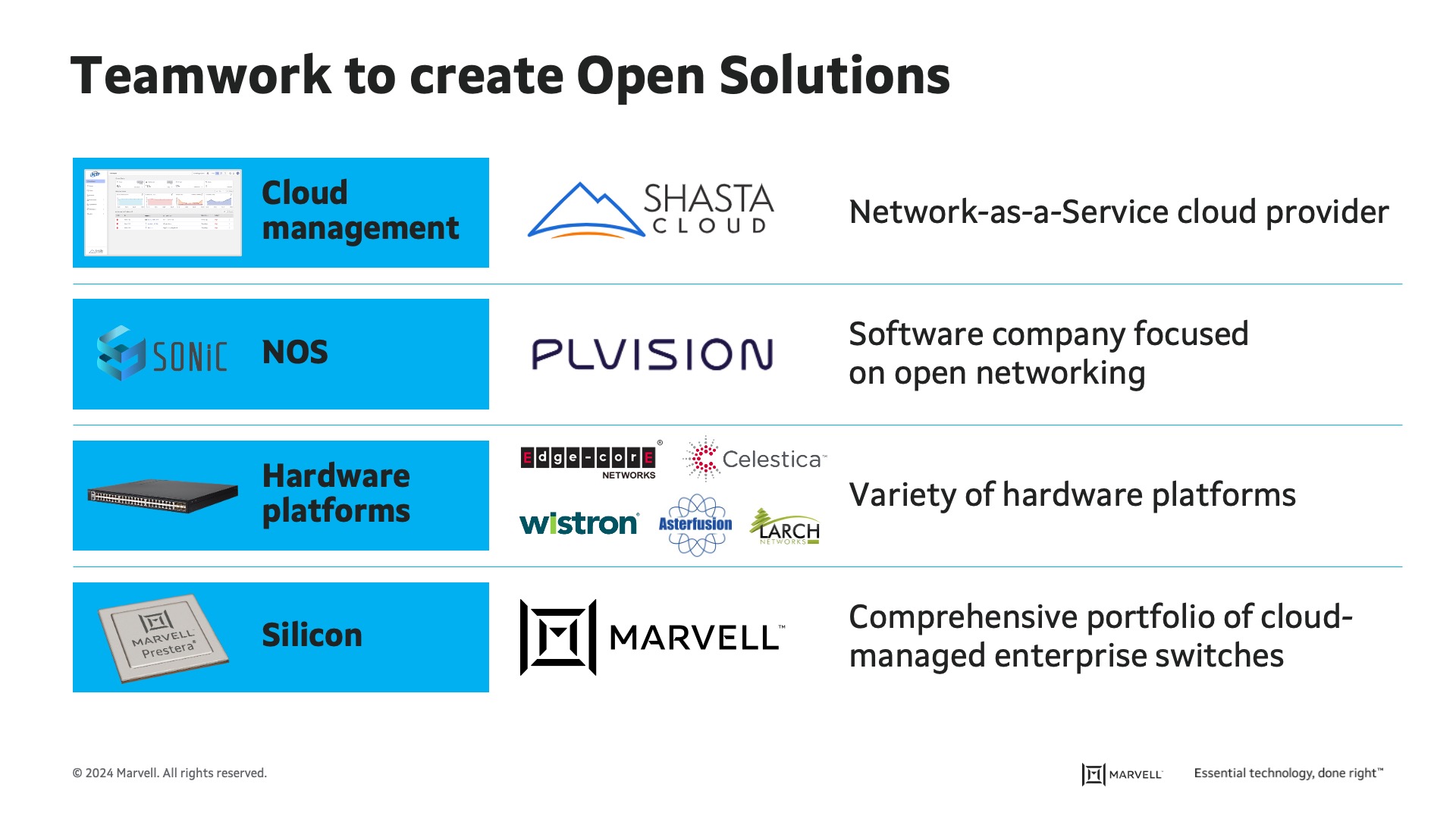
Figure 1: Breakdown of companies involved in OpenLAN Switching
By Mary Gorges, Content Manager, Talent Branding, Marvell
Welcome to the first of our four-part series on the "What Makes Marvell" blog, where we’ll highlight some of the incredible analog engineers making an impact at Marvell.
Think like an owner.” That’s the philosophy I find in the analog design teams at Marvell, and it’s something I take to heart every day. We really try to empower designers to take ownership of things.
I’m Tomas Dusatko and I’ve been part of Marvell’s analog engineering team in Vancouver since 2021. Before that, I moved here from Toronto and spent time working at PMC-Sierra, then later transitioned to Inphi in 2016, before finally joining Marvell through its acquisition of Inphi. Our Vancouver office may be small, with just 10-15 engineers and 5-6 analog designers, but we’ve been able to do some incredible work together. Typical project teams span multiple sites across the globe, and no matter where we are, there are opportunities to make significant contributions.
I got my start as a more traditional designer. Then I eventually transitioned my career into an architectural role at Marvell, focusing on clocking architectures. Clocking is a key component of high-performance interfaces, especially as we push the limits of technology to meet the needs of Next Gen data centers and AI connectivity. As we push data rates faster and faster, the quality of the clock and timing uncertainty starts to dominate link performance and is becoming a key area where we are trying to innovate. Over the years, I’ve led teams through various projects, starting at 7 nanometers and moving down to 5, 3, and now even 2 nanometer designs. These clocking architectures are used in most of Marvell’s optical connectivity products, and they’re critical for our success in the future 1.6TB market and our next-gen coherent DSPs.
By Mary Gorges, Content Manager, Talent Branding, Marvell

As we wrap up National Hispanic and Latinx Heritage Month, which runs from Sept. 15 to Oct. 15th, we pop into the home of one of our own employees for a very recognizable – and tasty – tradition.
At Marvell, fostering inclusion aligns with our core value of acting with integrity and treating everyone with respect, and shows up as we shine a light on the vibrant traditions and personal journeys of our employees.
By Tomas Dusatko, Distinguished Analog Engineer, Marvell
Welcome to the first of our four-part series on the "What Makes Marvell" blog, where we’ll highlight some of the incredible analog engineers making an impact at Marvell.

Think like an owner.” That’s the philosophy I find in the analog design teams at Marvell, and it’s something I take to heart every day. We really try to empower designers to take ownership of things. 
I’m Tomas Dusatko and I’ve been part of Marvell’s analog engineering team in Vancouver since 2021. Before that, I moved here from Toronto and spent time working at PMC-Sierra, then later transitioned to Inphi in 2016, before finally joining Marvell through its acquisition of Inphi. Our Vancouver office may be small, with just 10-15 engineers and 5-6 analog designers, but we’ve been able to do some incredible work together. Typical project teams span multiple sites across the globe, and no matter where we are, there are opportunities to make significant contributions.
I got my start as a more traditional designer. Then I eventually transitioned my career into an architectural role at Marvell, focusing on clocking architectures. Clocking is a key component of high-performance interfaces, especially as we push the limits of technology to meet the needs of Next Gen data centers and AI connectivity. As we push data rates faster and faster, the quality of the clock and timing uncertainty starts to dominate link performance and is becoming a key area where we are trying to innovate. Over the years, I’ve led teams through various projects, starting at 7 nanometers and moving down to 5, 3, and now even 2 nanometer designs. These clocking architectures are used in most of Marvell’s optical connectivity products, and they’re critical for our success in the future 1.6TB market and our next-gen coherent DSPs.