



By Vienna Alexander, Marketing Content Professional, Marvell
The semiconductor industry is an exciting place to build a career, especially with the exponential growth and demand for hardware innovation in the age of AI—the global semi market is approaching the $1 trillion mark, with 2027’s total market forecast at $831.5 million.1 For young engineers and talent, it provides an opportunity to solve complex problems and work on cutting-edge technology.
By Vienna Alexander, Marketing Content Professional, Marvell
Marvell was named to both U.S. News’ Best Companies to Work For and TIME’s list of America’s Best Companies for 2026.
By Vienna Alexander, Marketing Content Professional, Marvell
TIME Magazine has recognized Marvell as one of the World's Most Sustainable Companies for the third year in a row. Marvell is honored to have been represented since the origin of this ranking, as the company has demonstrated consistent, measurable progress across a number of sustainability initiatives.
By Michael Kanellos, Director of Content Marketing, and Vienna Alexander, Marketing Content Professional
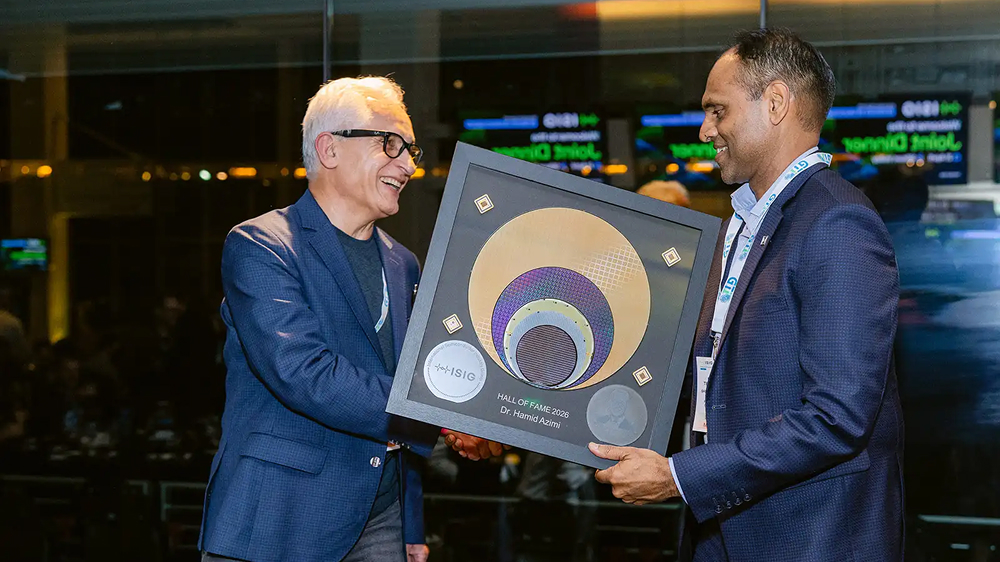
At the International Semiconductor Industry Group (ISIG) Executive Summit in Silicon Valley, Marvell Senior Vice President of Foundry and Advanced Packaging Dr. Hamid Azimi received the 2026 Hall of Fame award. This recognition celebrates leaders whose lifetime contributions have had a lasting impact, significantly advancing the semiconductor industry.
Over a career spanning more than 30 years, Dr. Azimi has led teams that have achieved numerous industry-leading advances in packaging. He was part of the team that developed the first flip-chip packaging with Ajinomoto Build-Up Film (ABF) substrates, a combination that enables engineers to design packaging containing far more and much smaller interconnects to improve signal integrity and power flow. Hamid and his team also enabled EMIB (Embedded Multi-Chip Interconnect Bridge) technology from scratch to high volume manufacturing. EMIB is the first 2.5 interposer-less panel level technology that enables ultra-large packages for AI data center products; he also has been a pioneer in glass substrates, a potential technology that could further enhance the capability of future generations of devices. Originally from a small village that “probably doesn’t even register on Google Maps,” Dr. Azimi holds over 40 patents. He earned a Ph.D. and M.S. in Materials Science from Lehigh University and a B.S. in Materials Engineering from Sharif University of Technology.
By Alua Suleimenova, Senior Sustainability Program Manager and Vienna Alexander, Marketing Content Professional, Marvell
This Earth Day, Marvell is proud to be recognized on USA Today’s America’s Climate Leaders 2026 list. This marks the second consecutive year Marvell has received this distinction, reflecting continued progress in reducing the company’s carbon footprint, increasing renewable energy procurement, and advancing toward sustainability targets.
This recognition builds on several other recent honors. Over the past year, Marvell has been acknowledged for its strong sustainability and ethics practices, including being named one of Ethisphere’s Most Ethical Companies, earning recognition as one of America’s Most Responsible Companies, and achieving CDP Sustainability Supplier Engagement Leader status. Together, these accolades underscore the commitment Marvell makes to responsible business practices across its operations, supply chain and products.


Copyright © 2026 Marvell, All rights reserved.